
.png)
WHAT IS ORGANIC RECYCLING?
The plain-English version.
Organic recycling, also called composting, its the process of turning food scraps, plant trimmings, and other organic waste into nutrient-rich soil instead of sending it to a landfill. When organic waste ends up in a landfill, it gets buried, breaks down without oxygen, and releases methane, a greenhouse gas that's roughly 80 times more potent than carbon dioxide. When the same waste gets composted, it breaks down naturally with oxygen and becomes something useful: clean, healthy soil that goes back into farms, gardens, and landscapes across Colorado.
Every banana peel, coffee ground, kitchen scrap, and yard trimming we pick up gets hauled to a licensed composting facility, processed into finished compost, and sold or used to grow more food. Nothing wasted. Everything returned. That's the whole point.
We Collect
Twice-weekly pickup from restaurants, hotels, and multifamily properties.
WE HAUL
Direct to a licensed Colorado composting facility.
IT RETURNS
Finished compost goes back into Colorado farms and gardens.
OUR CORE VALUES
Five principles that shape how we work, who we hire, and the way we show up every day.
INTEGRITY
We say what we mean and do what we say. Transparent, honest, and get what you see.
PASSION
We care about this work, the soil, the city, and the people we serve.
HUMILITY
We're new, we're learning, and we'd rather ask than assume.
COURAGE
Starting something honest in an industry built on opacity takes nerve.
FAITH
Half the job is in nature's hands. We do our part with care and trust the rest.
Five values. One promise. Show up, do the work, and let the rest take care of itself.
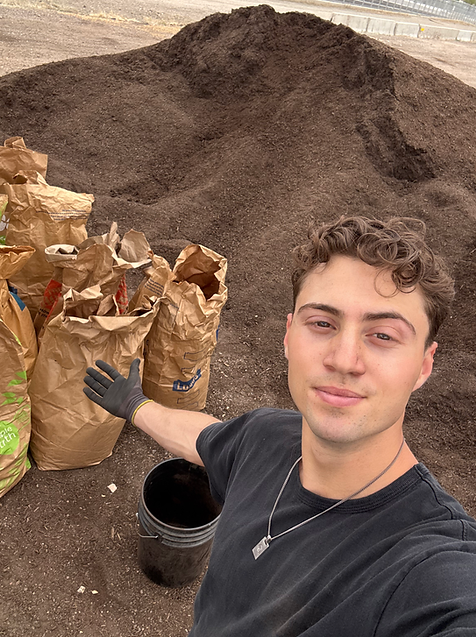
Ethan Babil ● Denver, CO
MEET THE FOUNDER
HEY, I'M ETHAN
Denver made a decision I already believed in. Starting September 1, 2026, composting and recycling stop being a nice idea and become the law. I started Melly's Recycling because that's a rare thing to get to build inside of: a city willing to put real weight behind the way I think waste should work.
Melly's isn't a hauler. We're a compliance company. The ordinance hands your business five requirements and a deadline, and we handle all five so you never have to learn what a Waste Diversion Plan is. The collection itself runs through our licensed hauling partner, coordinated by us, on bins we bring and manage.
The company is named after my mother, Mellisa. She taught me one thing that stuck harder than the rest: you finish what you started. That's not a slogan on a wall here. It's why your signage gets hung, your staff gets trained, your plan gets filed, and your service gets watched by someone whose only job is making sure it doesn't slip.
If you're a food service business's or property manager staring down September 1, you don't need another hauler. You need someone who makes compliance disappear. That's us.
The Philosophy Behind My Movement
A taste of my writing, and a good place to start if you want to understand how I think and why I took on a problem this big.
I came out of finance, private equity and banking. Then I walked away to learn this business from the ground up. I drove a garbage truck through Denver before sunrise. I stood on the floor of transfer stations and landfills next to the people who see it every day. I sat across the table from the executives who turn a government mandate into a market. I wanted to see all of it before I built anything.
Here is what I saw. When Denver passed its composting mandate, the big waste companies did not see a rule. They saw a market. And the people who get crushed in that shuffle are always the same: the mom and pop shop, the family restaurant that has fed one neighborhood for two generations, the place where someone's whole culture shows up as food. They are not fighting sustainability. They are trying to make a living. Melly's exists so the mandate does not cost them that living.
So today we do the necessary, unglamorous work. We make Denver businesses compliant with the composting law: the signage, the training, the hauling, the paperwork, without the fines and without the headache. Especially for the neighbors everyone else overlooks.
But compliance is the front door, not the house. What everyone else calls trash, we call feedstock. Food waste is not the end of something. It is the input to compost, to renewable natural gas, to animal feed, three of the most expensive things a farm has to buy. Control the waste and you can lower the cost of growing real food close to home. That is where Melly's is headed: affordable, localized, whole foods for the communities that need them most. We start with a compost bin. We are aiming at the food system.
If you want the whole vision, the narrative I am actually betting on and why, I wrote it down.